
 Bobby Wilson
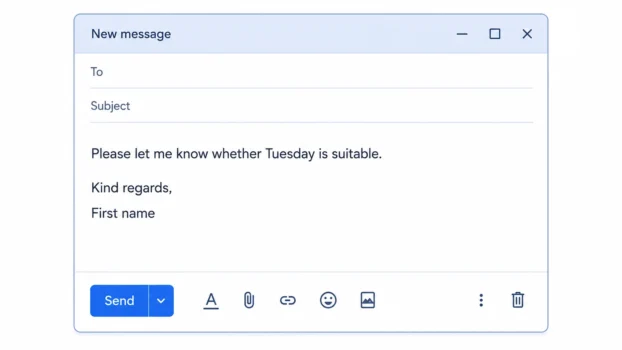
An email normally ends with a final sentence, a suitable sign-off and your name. The final sentence can ask for a reply, thank the recipient, confirm what happens next or close the conversation naturally. Choose a sign-off that matches the tone of the message and your relationship with the recipient.
The simplest way to end an email
A simple email ending follows this structure:
Final sentence → sign-off → name
The final sentence completes the message. The sign-off is the short phrase before your name, such as “Best wishes” or “Kind regards”.
An email asking for a response might end like this:
Please let me know whether the appointment can be changed.
Kind regards,
First name
A message thanking someone could end like this:
Thank you for sending the photographs.
Best wishes,
First name
An informal message may be shorter:
Speak to you soon.
Cheers,
First name
The ending is the final part of writing an email. It should complete the purpose of the message and make any required response or next step clear.
What should the final sentence say?
The final sentence should bring the message to a natural end. It does not need to repeat everything you have already written.
When you need an answer, state what you would like the recipient to tell you:
Please let me know which date is most suitable.
When someone has helped you, a simple thank-you may be enough:
Thank you for your help with this.
You can also confirm what you will do next:
I will send the updated information tomorrow.
Where appropriate, you can offer further help:
Please contact me if you need any other information.
An informal conversation might end with:
Speak to you soon.
Not every email needs to ask for a reply or include a thank-you. The final sentence should reflect what needs to happen after the message has been read.
Which email sign-off should you use?
A sign-off is the short phrase placed between the final sentence and your name. No single sign-off is suitable for every email.
Thanks works naturally when you are thanking the recipient or making a routine request. “Thank you” has the same basic meaning and may sound slightly more formal.
Best wishes is friendly and polite. It can suit personal messages and many ordinary professional emails.
Kind regards is respectful without being highly formal. It commonly suits messages to companies, teachers, colleagues and people you do not know well.
Regards is shorter and more reserved. It remains polite, but may feel less warm than “Kind regards”.
Yours sincerely and Yours faithfully are traditional formal choices in British English. “Yours sincerely” is normally used when the recipient has been addressed by name. “Yours faithfully” is traditionally used when their name is unknown.
Cheers is an informal British sign-off. It may suit friends, relatives and familiar colleagues, but it can be too casual for a formal first message.
A comma is commonly placed after the sign-off, with your name on the following line:
Kind regards,
First name
A typed sign-off is separate from an automatic email signature. An automatic signature is saved information that may appear beneath your message, such as your name and contact details. You can still type a final sentence and sign-off above it.
How to end an informal email
Emails to friends, relatives and people you know well can use shorter and more relaxed endings.
You might finish with a direct sentence and your first name:
Thanks, that was really helpful.
First name
You can also use an informal sign-off:
I will see you on Saturday.
Cheers,
First name
People in an ongoing conversation may sometimes leave out a separate sign-off when the meaning and sender are already clear.
Informal does not mean careless. The ending should still make sense and suit the relationship.
How to end a formal or professional email
A formal or professional email will normally end with a clear final sentence, a neutral or formal sign-off and your name.
For example:
Please let me know if you require any further information.
Kind regards,
First name
A more formal message addressed to a named person could end with:
Thank you for your assistance.
Yours sincerely,
First name
The traditional distinction between “Yours sincerely” and “Yours faithfully” is still useful in formal British correspondence, but most modern professional emails do not need such a formal ending.
“Kind regards” and “Best wishes” are suitable in many ordinary professional situations. The wording should be clear and natural rather than formal for its own sake.
How to end an email when you need a reply
When you need the recipient to answer or take action, make the request clear in the final sentence.
You could write:
Please let me know whether Tuesday is suitable.
When a particular fact needs confirming:
Could you confirm whether the document is available?
When the timing matters:
Please reply by Friday if possible.
Being polite does not require hiding the request behind vague or complicated wording. A specific sentence helps the recipient understand what answer or action is needed.
A complete ending might be:
Could you confirm whether the document is available?
Kind regards,
First name
Should you write “I look forward to hearing from you”?
“I look forward to hearing from you” is a common and acceptable final sentence. It can suit a formal or professional message when you expect a response.
It is optional.
Where you need a particular answer, a direct question may be clearer:
Please let me know whether Tuesday is suitable.
“I look forward to hearing from you” shows that a response is expected. A direct question tells the recipient exactly what information you need. Choose the wording that best completes the purpose of the email.
How to end a reply
Replies in an ongoing conversation can often end more briefly than the first message.
A short confirmation may need only a sentence and your name:
Thanks, that works for me.
First name
A slightly fuller reply could use a sign-off:
I will send the document tomorrow.
Best wishes,
First name
Very short exchanges do not always need a new greeting, closing sentence and formal sign-off each time. The recipient should still be able to understand your answer and identify who sent it.
Examples of how to end an email
Asking an ordinary question
Could you tell me whether the office is open on Monday?
Best wishes,
First name
Thanking someone
Thank you for taking the time to explain the process.
Best wishes,
First name
Making a professional request
Please send the revised form by Thursday if possible.
Kind regards,
First name
Ending a formal message
Please contact me if you require any further details.
Yours sincerely,
First name
Finishing an informal reply
Great, I will see you there.
Thanks,
First name
A useful email ending does not need complicated wording. It should complete the message, make any next step clear and use a sign-off that suits the recipient. The tone used to start an email should normally continue through the final sentence and sign-off.