
 Bobby Wilson
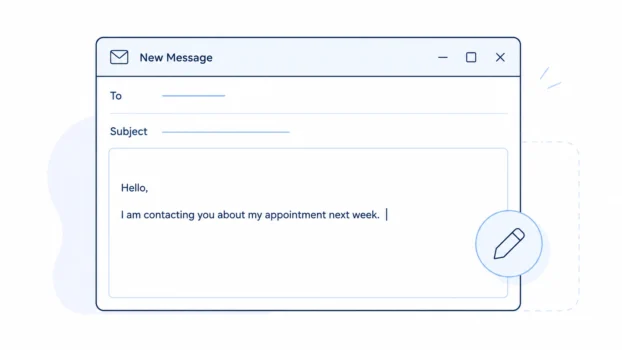
Start an email with a greeting such as “Hi”, “Hello” or “Dear”, followed by the recipient’s name when you know it. On the next line, explain why you are writing. When the recipient does not know you, add a brief introduction or identifying detail before stating the purpose of the message.
The simplest way to start an email
Most email openings follow this basic structure:
Greeting → optional introduction → reason for writing
For someone you know, you might write:
Hi [First name],
Are we still meeting at 2 pm on Tuesday?
When contacting someone for the first time, you could write:
Hello [First name],
I am contacting you about my appointment next week.
When writing to a company or team, you could use:
Hello,
I am contacting you about booking reference 12345.
The opening does not need to be long. A suitable greeting and one clear sentence are often enough.
A clear opening gives the recipient the context they need before reading the rest of the message. It is one part of writing an email, alongside the subject, main message and ending.
Should you use Hi, Hello or Dear?
“Hi”, “Hello” and “Dear” can all be suitable ways to begin an email. The best choice depends on who you are contacting and how formal the situation is.
Hi [First name], is friendly and relatively informal. It commonly suits friends, relatives, colleagues and other people with whom you normally use first names.
Hello [First name], is friendly but more neutral. It can work in many personal, practical and professional situations.
Dear [First name], is more formal. It may suit a first contact or a situation where a more traditional tone is expected.
For example:
Hi [First name],
Could you send me the photographs from Saturday?
Hello [First name],
I am contacting you about the document you requested.
Dear [First name],
I am writing to confirm my appointment on Tuesday.
“Dear” is not required simply because an email concerns work, education or an organisation. “Hi” is also not automatically unsuitable in a professional email.
Use the greeting that fits the relationship and situation. When replying to someone, the way they addressed you may help you choose an appropriate level of formality.
Check the spelling of the recipient’s name before sending. Do not guess a title such as Mr, Mrs, Ms, Dr or Professor when you do not know whether it is correct.
What should you write after the greeting?
The first sentence should normally help the recipient understand why you are writing.
You can begin with a direct question:
Could you confirm whether Tuesday is suitable?
You can explain the reason for contacting someone:
I am writing to ask whether my booking can be changed.
You can thank the recipient:
Thank you for sending the document.
You can refer to an earlier conversation:
Following our conversation, I am sending the information you requested.
You can confirm a plan:
Are we still meeting at 2 pm on Tuesday?
You do not always need to begin with “I am writing to”.
Compare these examples:
I am writing to ask whether the appointment is still scheduled for Friday.
Could you confirm whether the appointment is still scheduled for Friday?
Both are clear. The first is slightly more formal. The second is more direct.
Being direct is not the same as being rude. The sentence should contain enough information for the recipient to understand the question or request.
How to start an email when you do not know the person’s name
When you know the recipient’s name, you can normally use it:
Hello [First name],
or:
Dear [First name],
When you do not know who will read the email, a neutral greeting is often enough:
Hello,
You can also address the relevant team:
Dear Customer Support Team,
Dear Appointments Team,
Hello Booking Team,
Using a team or department name is usually clearer than guessing a person’s name, title or gender.
Older greetings such as “Dear Sir or Madam” and “To whom it may concern” are still understood, but they can sound impersonal. A person’s name, a team name or a neutral “Hello” will often sound more direct and natural.
After the greeting, explain what the message concerns:
Hello,
I am contacting you about booking reference 12345.
Dear Customer Support Team,
Could you confirm whether my order has been sent?
When should you introduce yourself?
Introduce yourself when the recipient may not know who you are or needs more information to identify you.
For example:
My name is First name, and I am contacting you about my appointment.
My name is First name, and I attended the event on Saturday.
I am contacting you about booking reference 12345.
A useful introduction may include your name and one relevant detail, such as:
- An appointment date.
- A booking reference.
- A course or class.
- An event you attended.
- An earlier enquiry or conversation.
You do not need to provide your full background.
For example, this is usually enough:
Hello,
My name is First name, and I have an appointment booked for Tuesday morning.
The recipient now knows who is writing and what the message concerns.
You normally do not need to introduce yourself when emailing someone who already knows you.
Should you write “I hope you are well”?
“I hope you are well” is an optional polite opening.
You could write:
Hello [First name],
I hope you are well. I am contacting you about my appointment next week.
You could also move directly to the purpose:
Hello [First name],
I am contacting you about my appointment next week.
Neither version is automatically more polite or professional.
Use “I hope you are well” when it feels natural for the relationship and situation. Avoid adding several general pleasantries if they make the reason for writing difficult to find.
How to start a reply
A reply does not usually need the same introduction as a first message.
You can begin by acknowledging what the other person sent:
Hi [First name],
Thank you for your email.
Hello [First name],
Thank you for sending the document.
You can also answer the previous message directly:
Hi [First name],
Tuesday at 2 pm works for me.
In a short ongoing conversation, it may be natural to leave out the greeting and answer the question immediately:
Yes, Tuesday at 2 pm is suitable.
Whether you repeat the greeting in every reply depends on the length and tone of the conversation. There is no need to restart the exchange with a formal introduction each time.
Examples of how to start an email
Asking someone you know a question
Hi [First name],
Could you let me know whether you are free on Saturday?
Contacting someone for the first time
Hello [First name],
My name is First name, and I am contacting you about the event next week.
Contacting customer support
Dear Customer Support Team,
I am contacting you about booking reference 12345.
Replying to an earlier message
Hello [First name],
Thank you for getting back to me.
Beginning a more formal message
Dear Appointments Team,
I am writing to ask whether my appointment can be moved to a later time.
Each opening addresses the recipient and makes the reason for the message clear. The wording changes, but the basic purpose remains the same.
Before continuing, check that the recipient’s name is correct and that the first sentence explains why you are writing. Avoid guessing titles or adding background information the recipient does not need.
The tone used to end an email should normally match the greeting and wording used at the beginning.
Starting an email does not require complicated wording. Use a greeting that suits the recipient, introduce yourself when necessary and explain why you are writing.